

CAREER · 1 NOVEMBER 2026
Indian job ads ask for a resume, a CV or a biodata, and the three words get mixed up all the time. This article explains each one in plain words, with a side-by-side table and clearly labelled samples, so you send the right document every time.
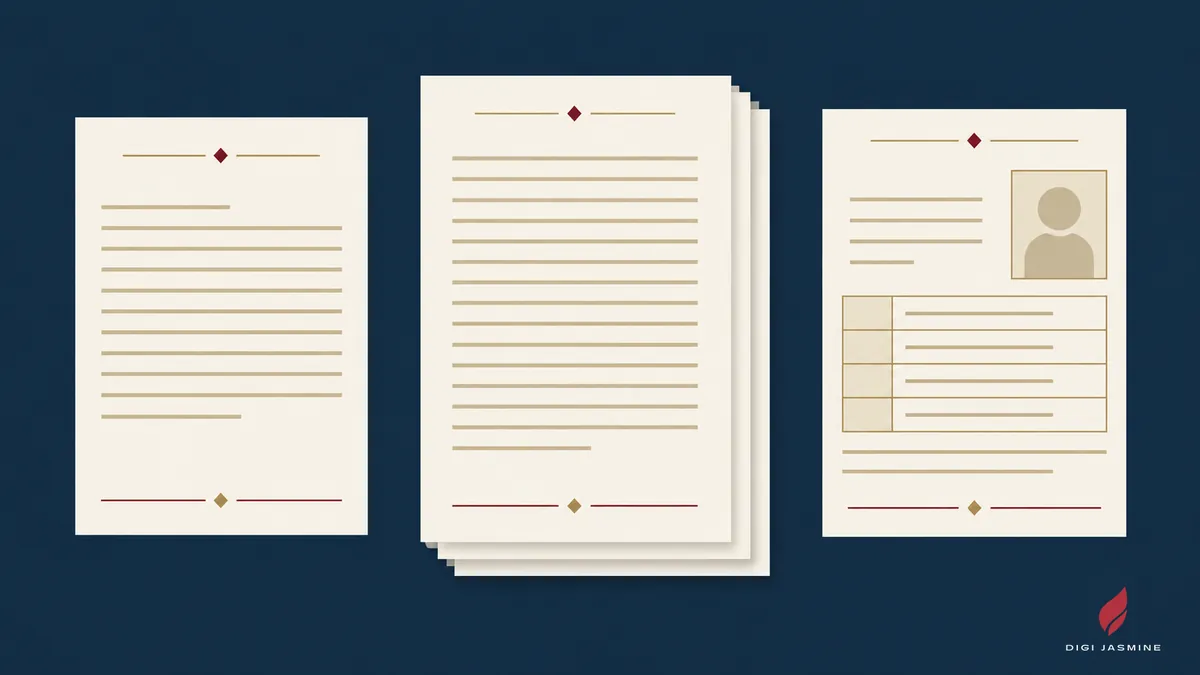
Cover design: Digi Jasmine. Illustrated artwork, not a screenshot.
The short answer
Send what the employer asks for. In India, the words resume and CV usually mean the same short, one or two page document, so for many private-sector applications the same tailored employment document works; follow the notice if it specifies something different. A long, full-history CV is for academic, research and scholarship applications. If a government notice or form says biodata, fill that biodata format. When the ad does not say, a clean one or two page resume is the safe choice for private jobs in India.
Everything below explains what each document is, who still asks for it, and what to do when the ad is vague. The lengths and habits described are common conventions, not fixed rules: the employer’s instructions always win. You need about ten minutes to read it, and you will not mix the three up again.
1. Why the three words get mixed up
These three documents grew up in different places. The word resume comes from French and means a summary. CV is short for the Latin curriculum vitae, the course of your life. Biodata is short for biographical data, a format South Asia made its own.
In India the words blur together in daily use. Many private companies say CV when they mean a one page resume. Some government offices still print biodata forms. And many families first hear the word biodata in a marriage context, which is a different document again. No wonder freshers are confused.
The good news: you rarely have to choose by yourself. The employer usually names the document in the ad, the email or the application form. Your job is to notice which word they used and send exactly that.
2. The three documents side by side
Resume, CV and biodata compared, based on common practice in India today. These are conventions, not rules: the employer’s instructions decide.
| Resume | CV | Biodata | |
|---|---|---|---|
| How long | Usually one to two pages | Same as a resume in most Indian job ads; longer for academic use | Usually one to two pages, and often a fixed form |
| What it covers | Only what fits this job: skills, recent work, education | In India, usually the same as a resume. An academic CV lists your full education, research and work history | Personal details first, then education and work in date order |
| Personal details | Usually just name, phone, email and city | Same as a resume | Whatever the form asks: often date of birth, gender, marital status and full address |
| Photo | Not expected, unless asked | Not expected, unless asked | Often asked for, pasted at the top |
| Who usually asks | Private companies, startups, IT, most fresher jobs | Private employers mean a resume; colleges, research, teaching and scholarships may want the full version | Some government recruitment and traditional employers; marriage proposals use a different biodata |
| Changes per job | Yes, tailor it every time | Tailor it like a resume; keep an academic CV complete and updated | Fixed facts, rarely changed |
3. Resume: what it is and when to send it
A resume is a short, sharp summary built for one specific job. It carries your contact details, a one line headline, the skills that match the role, your education, and your work or project experience. For a fresher in India, one page is usually enough.
Send a resume when a private company, startup, agency or IT firm asks for one, asks for a CV, or when the ad does not name any document. Recruiters in private companies skim fast, so a resume leaves out anything that does not help this application.
- One page usually fits a fresher, two at most with a few years of work. If the employer states a length, follow that.
- Change it a little for every job so the skills they ask for are easy to find.
- No date of birth, religion, marital status or photo, unless the employer asks. Private companies usually do not.
We wrote a full walkthrough with worked examples: Resume for freshers in Odisha.
4. CV: what it is and when to send it
Here is the Indian reality first: in most Indian job ads, the words CV and resume mean the same short document. Indeed India says the two terms are used interchangeably in India and that most employers accept either. So if a private company asks for your CV, send your resume.
The separate, longer CV exists for a narrower set of readers: colleges, universities, research organisations and scholarship committees. That document is a complete record of your education, research and work history in date order, and it grows as your career grows. These readers want the whole story, not a summary.
Applying to another country? Conventions change at the border. In the US and Canada, industry jobs ask for a resume and CVs are mainly academic. In the UK and much of Europe, the word CV is standard, but the document employers expect is still a short employment summary, much like a resume. Read the ad and follow that country’s habit.
5. Biodata: what it is and when to send it
Biodata means biographical data. It starts with who you are as a person: full name, date of birth, gender, marital status, address and often a photo, and then lists your education and work in date order.
Send a biodata when an employer or a government notice asks for one. This is not a guess: some government recruitment still runs on biodata forms. One current example is a 2026 recruitment notice from U.R. Rao Satellite Centre (ISRO), Department of Space, which attaches a “Bio-Data Format” form asking for your full name in block letters, date of birth, marital status and both addresses. That form shows what this one employer asks; other notices use their own forms. When a notice gives you a fixed form, fill that form and nothing else, and give only the details it asks for.
A marriage biodata is a separate document for families, with details like height and family background. It has nothing to do with jobs, so do not send it to an employer.
6. When the job ad is not clear

Some ads say nothing, or mix the words up in one sentence. Work through these steps in order.
- Read the ad and the application form once more. The document is usually named somewhere, even in small print.
- Follow any format instructions exactly: file type, file name, photo, copies.
- If a government notice includes its own form or proforma, use it. Do not attach your own design instead.
- If a private company stays vague, send a one or two page resume as a PDF. That is what they expect, whatever word the ad used.
- If you are still unsure, a short polite email or WhatsApp message to the recruiter asking which document they prefer is completely fine.
7. The first lines of each one, with samples
These three openings are fictional samples made for this article, but they show how different the documents feel from the very first line.
Resume (fictional sample)
Rohit Sahoo | Bhubaneswar | rohit.sahoo@email.com | B.Com graduate seeking an accounts role. Skills: Tally, Excel, GST basics. Straight to the point, one page.
CV for academic use (fictional sample)
Rohit Sahoo, B.Com. Education: his courses and certificates with years. Projects, workshops, awards, internships, in date order. Two pages or more. For private jobs, Rohit sends the one page resume above instead.
Biodata (fictional sample)
Name: Rohit Sahoo. Father’s name: Suresh Sahoo. Date of birth: 12 March 2003. Marital status: Unmarried. Address: … Then education and work history in date order, photo at the top.
All three people are fictional and created for this article. Any resemblance to a real person is a coincidence.
8. Mistakes to avoid
- Sending a biodata with religion, caste or marital status to a private company. They did not ask, and it can work against you.
- Sending a four page CV to a startup. A busy founder will not read it.
- Using the same file everywhere without reading the ad first.
- Adding a photo to a resume for a private job. It is not expected, and many recruiters prefer without.
- Sending a marriage biodata for a job. It is a different document.
- Naming the file finalresume2.docx. Use your name and the role: Rohit-Sahoo-Accounts.pdf.
- Paying anyone who promises a job for money. Real employers never charge a fee to hire you.
9. Questions people ask
Is a CV the same as a resume in India?
In private jobs, yes. Indeed India says the two words are used interchangeably in India and most employers accept either. A different, longer CV exists for academic, research and scholarship applications.
Do government jobs in India need a biodata?
Some do. Certain government recruitment notices attach their own bio-data form, for example ISRO’s U.R. Rao Satellite Centre. Other notices ask for a CV or their own online format. Always follow the notice and fill the official form if one is given.
Should I add a photo?
Only for a biodata or when the ad asks for one. A resume for a private job usually does not need one.
How long should a fresher’s resume be?
One page is usually enough. You do not have ten years of work to show yet, and one honest page beats two padded ones. If an employer asks for a set length or format, follow their instruction.
The ad says send your CV but I have a resume. What now?
Send your resume. In Indian private hiring the two words are used for the same short document, and a neat one page resume is what the recruiter expects.
Which document do companies abroad want?
It depends on the country. In the US and Canada, industry jobs want a resume. In the UK and much of Europe they say CV but mean a short employment summary, much like a resume. The long, full-history CV is mostly for academia, wherever you apply. Check the ad and the country’s habit.
Should I send a PDF or a Word file?
PDF, unless the ad asks for Word. A PDF keeps your layout exactly as you designed it on every phone and computer.
Picked your document? Now make it worth reading
Knowing which document to send is the first step. The second is making it clear, honest and easy to read, because recruiters decide in seconds whether to keep reading.
If you want a hand, Digi Jasmine designs resumes and CVs for freshers and working professionals across Odisha, with the same honest, no-shortcuts approach as this article. Resume services start at ₹499, and the Career Branding Bundle (resume, LinkedIn profile and portfolio support) is ₹1,499, prices as listed on the Resume, CV and Personal Branding page today.
Sources
Indeed India: The difference between CV, resume and biodata
in.indeed.com/career-advice/resumes-cover-letters/difference-between-cv-and-resume-and-biodata
Indeed India: CV template and samples (states that resume and CV are used interchangeably in India)
in.indeed.com/career-advice/resumes-cover-letters/cv-template
Indeed UK: Resume vs. CV (regional conventions, including India)
uk.indeed.com/career-advice/cvs-cover-letters/resume-vs-cv
Resume.io: Biodata vs. resume or CV
resume.io/blog/biodata-resume
U.R. Rao Satellite Centre (ISRO), Department of Space: Bio-Data Format for recruitment
isro.gov.in recruitment bio-data form (PDF)